200 Applications. Which CV Should You Open First?
Candidate applications may arrive randomly, but your review order does not have to. See how Candidate Ranking can help recruiters organise applicants by relevant skills, experience and role fit for a clearer review process.
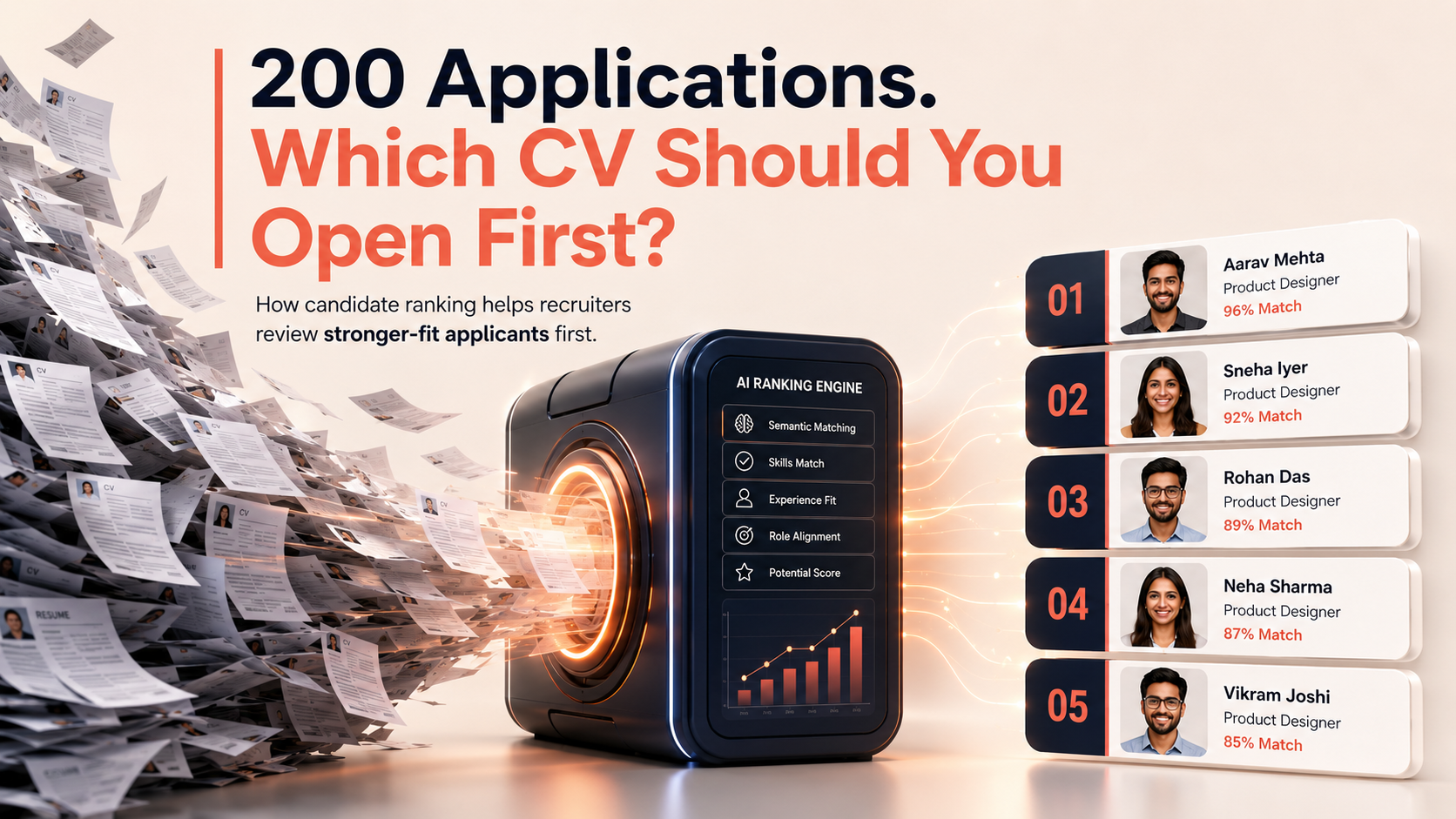
09:07 AM — Application #001 arrives.09:11 AM — #002.11:48 AM — #63.5:26 PM — #200.
The next morning, the recruiter opens the inbox.
And here is where something strange happens:
The order in which people applied quietly becomes the order in which they are reviewed.
But “first received” and “best fit” are not the same thing.
The real hiring problem is not always a shortage of candidates.
Sometimes it is a queue with no intelligence behind it.
The Problem Isn’t 200 Applications. It’s 200 Equal Starting Positions.
Picture a strong candidate sitting at position 147.
Their experience is relevant. Their skills closely match the role. Their background deserves attention.
But before the recruiter reaches them, 146 other CVs are waiting.
Manual screening often forces recruiters to repeat the same early checks again and again: role relevance, experience, key skills, obvious mismatches and basic qualification signals.
The work is necessary.
The order is not always useful.
That is where AI-assisted candidate screening can help change the starting point.AI-assisted screening can help recruiters identify applicants who may deserve closer review based on job-relevant information, while the recruiter remains responsible for evaluating the candidate and making the hiring decision.
Chaos → Ranking → Human Review
The goal should not be:
“Let AI decide who gets the job.”
A better goal is:
“Help the recruiter decide where to look first.”
AI-assisted candidate screening can organise applicants using job-relevant signals such as skills match, role fit and experience, then create a clearer review queue.
The recruiter still reviews the profile, checks context, questions the result and makes the hiring decision.
Think of it as attention management.
AI helps organise the queue.Humans evaluate the person.
That distinction matters.
The 200-CV Test
Imagine you are hiring a Product Designer.
Morning A
Open CV #1.Open CV #2.Open CV #3.Keep going.
Morning B
Review applicants based on relevant job criteria.
Start with applicants whose profiles show the strongest match against the role criteria.
Review the highest-priority candidates first.
Then continue through the wider pool.
The applications still arrived randomly.
Your review order did not.
The potential benefit is a more structured first-pass review, helping recruiters focus their attention on applicants who appear relevant while still considering the wider candidate pool.
But Ranking Is Only as Good as the Question You Ask
Before ranking candidates, the hiring team should be able to answer:
What actually matters for this role?
Not ten paragraphs of generic requirements.
The real criteria.
Which skills are essential?
Which skills are trainable?
How much experience is genuinely required?
What evidence would make someone worth a closer look?
What should never be used as a shortcut for job-related evaluation?
A weak job definition can produce a less useful screening process.
A clear role definition gives the recruiter something meaningful to rank against.
Where This Fits Inside TrueValue
Recruitment is not an isolated moment.
After a candidate moves forward, the business still has interviews, decisions, employee records and onboarding to manage.
TrueValue Platform publicly describes its HR capabilities as covering employees, attendance, leave, recruitment, onboarding and HR reporting.
That makes candidate review part of a wider people workflow rather than a disconnected inbox.
Explore the TrueValue Product Showcase to see how connected Products are positioned across the wider platform.
And once a candidate becomes an employee, the next operational question is obvious:
What happens on Day One?
The guide to employee onboarding for growing teams is a useful next read.
Candidate Data Needs Care Too
CVs contain personal information.
Ranking should never mean:
“Collect everything and expose it everywhere.”
Access, permissions and security matter.
Teams evaluating recruitment technology should also consider how candidate and employee information is protected. TrueValue publishes dedicated security practices covering its broader approach to platform protection and access controls.
The Better Starting Question
Most hiring teams ask:
“How do we review all these applications faster?”
A more useful question may be:
“Which applications deserve our attention first — and why?”
That changes the conversation.
It moves hiring away from inbox order and toward deliberate review priority.
Applications may always arrive randomly.
Your attention does not have to.
AI-assisted candidate screening is not about removing the recruiter from hiring.
It is about helping recruiters spend less energy sorting and more energy evaluating.
Want to understand the thinking behind the wider connected platform? Read About TrueValue Platform.
Or, if your team is exploring recruitment, HR or connected business workflows, request a personalised demo and see how the platform could fit your process.
Related Articles & Insights
Continue exploring connected workflows, product playbooks, and strategic guides.

The Real AI Transformation Is Workflow Redesign — Not Just Adding Another Tool
Adding AI to an old workflow does not automatically transform work. Learn a practical five-step method for redesigning processes around people, ownership and AI.
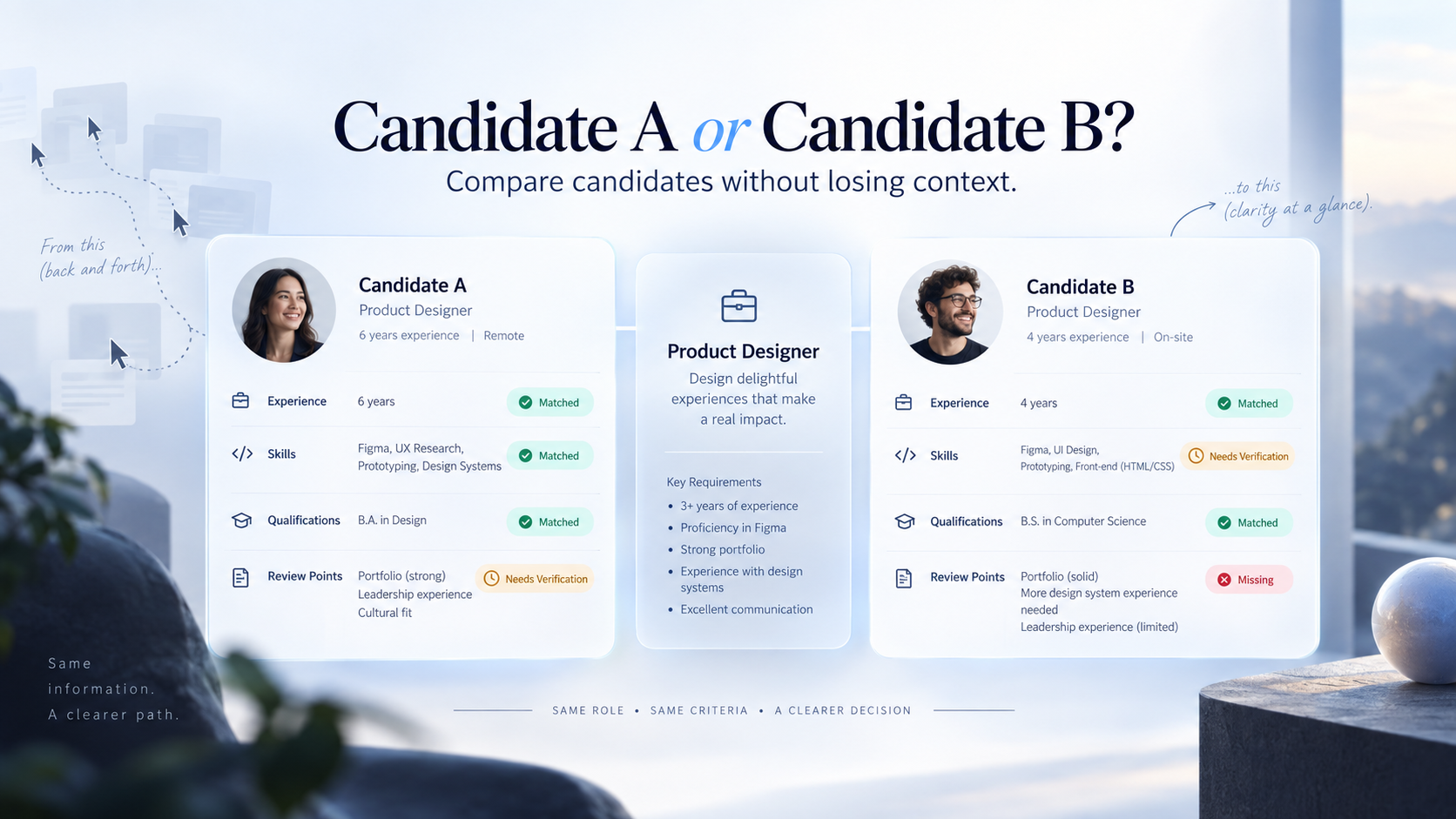
Candidate A or Candidate B? How to Compare Candidates Without Losing Context
Learn how to compare two candidates against the same role context, separate evidence from uncertainty and turn unclear information into better hiring questions.
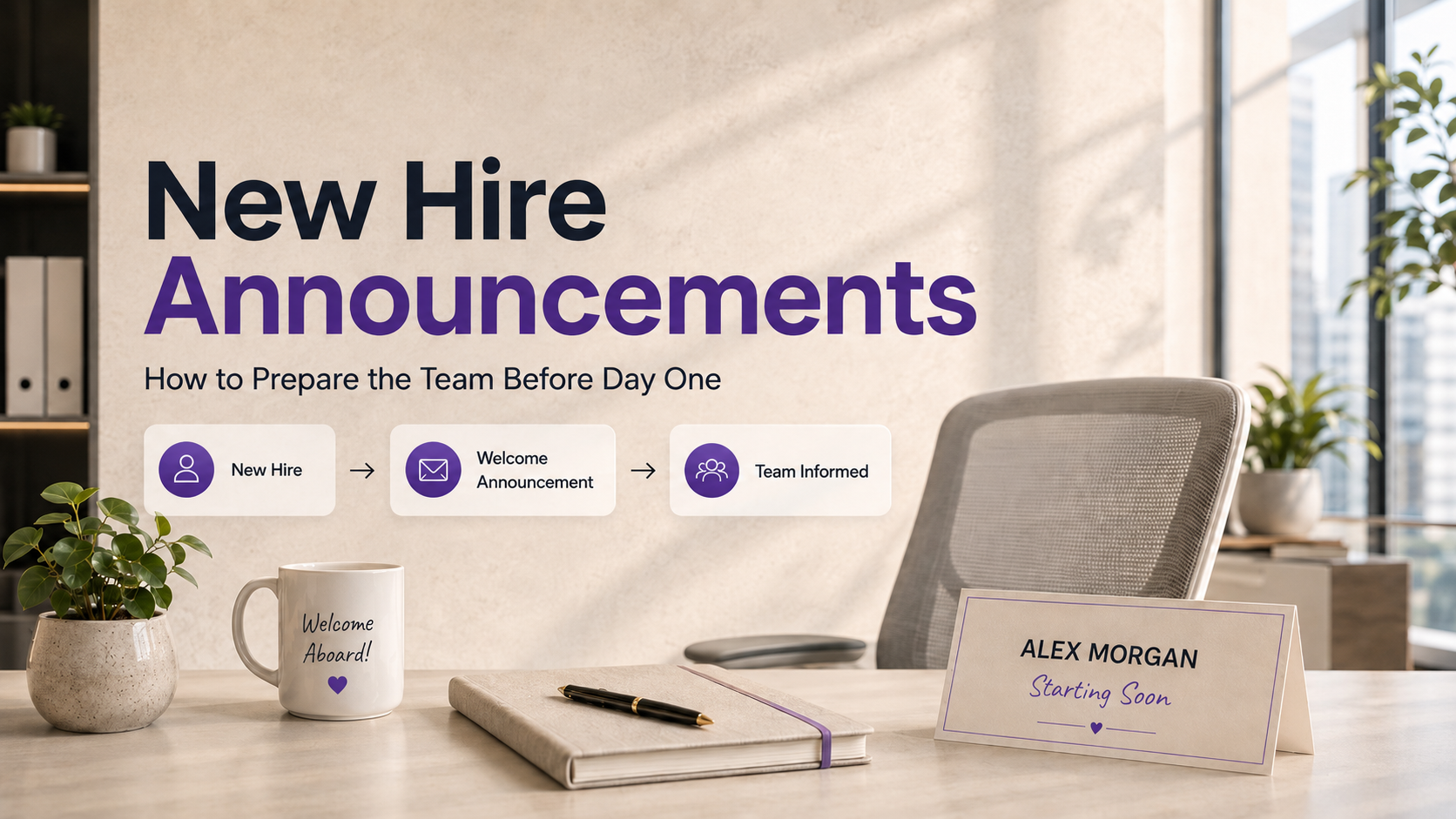
New Hire Announcements: How to Prepare the Team Before Day One
A practical guide to new hire announcements: what to include, when to send them, who should own the process, and how better pre-start communication supports onboarding.