Your Website Is Getting Fewer Clicks. Make Each Visit Count.
Zero-click search is changing website traffic. Learn how to turn fewer, higher-intent visits into connected enquiries and customer journeys.
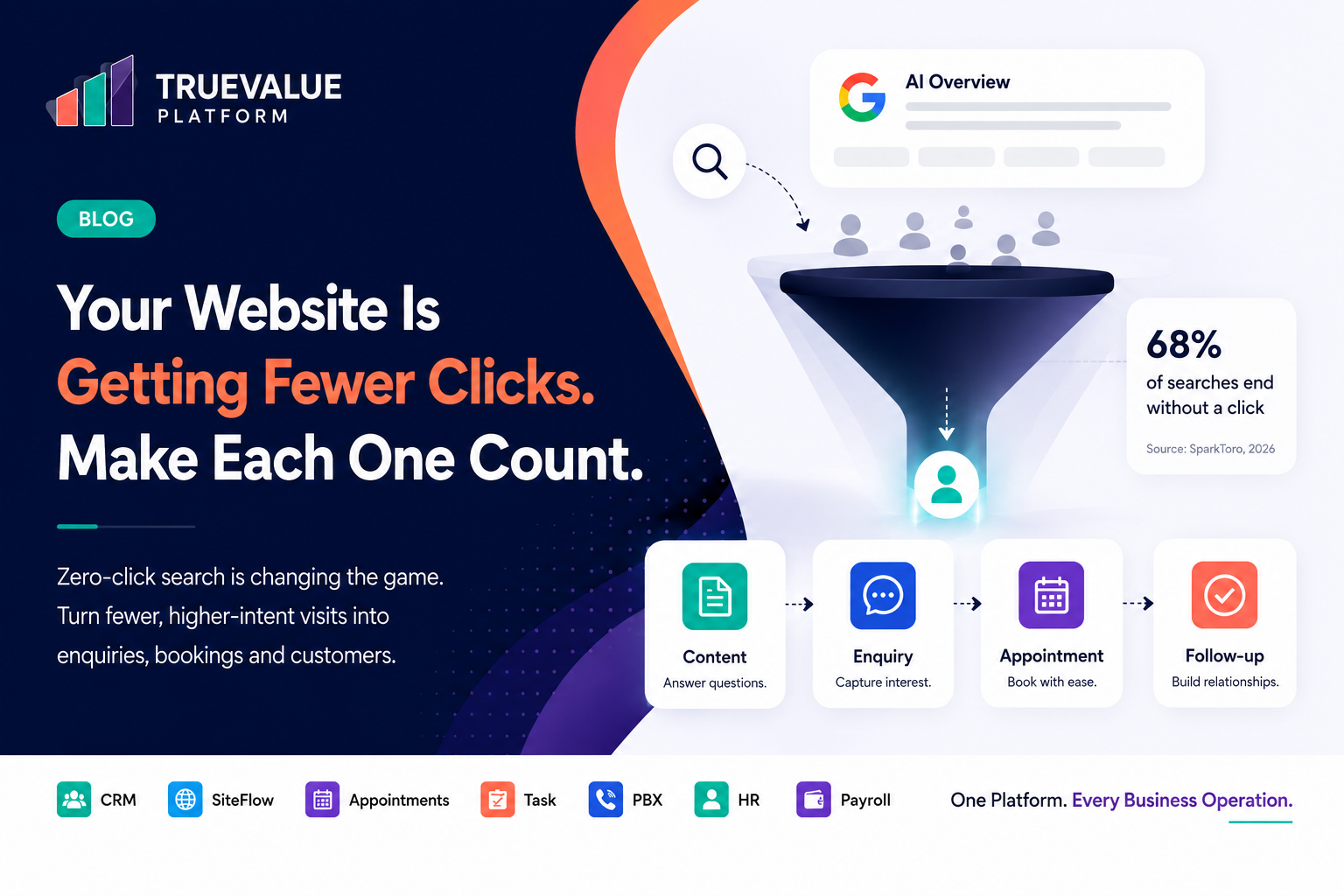
Zero-Click Search Is Rising: Make Every Website Visit Count
Zero-click search is changing how people discover businesses. Learn how clearer content, forms and next steps can help the visitors who do arrive move through a more useful customer journey.
A potential customer searches for a service your business provides.
A few years ago, they might have opened several websites, compared the options and submitted an enquiry.
Today, the search page may answer much of their question before they visit a website. They might read an AI-generated summary, check a map result, scan reviews or compare businesses without leaving the search experience.
When they finally click, they are often deciding whether your business deserves the next step.
That changes the role of your website.
The old objective was to attract as much traffic as possible.
The new challenge is to make every visit more useful by helping people find the right information and move towards an appropriate action.
The easy click is becoming less common
Zero-click search is not new, but answer-led search experiences are making it more important.
A 2026 analysis published by SparkToro using Similarweb clickstream data estimated that 68.01% of US Google searches ended without a click from January to April 2026. The analysis used Similarweb’s desktop and mobile browser panel and did not include searches conducted inside Google’s mobile app.
Earlier research from Pew Research Center found that US users clicked a traditional search result in 8% of visits where an AI summary appeared, compared with 15% of visits without one. The study was based on browsing data from 900 US adults in March 2025.
Both studies examined US search behaviour. Results may differ by country, device, query type and the search features displayed.
These findings do not mean search optimisation no longer matters.
Google’s current guidance for generative AI features in Search says that established SEO practices remain relevant. It recommends useful, original content, clear technical structure, crawlable pages and a strong page experience.
The opportunity is still there. The nature of that opportunity has changed.
As search experiences answer more questions directly, the visitors who do arrive may expect faster answers and a clearer route forward.
The hidden problem is not always traffic
Imagine a hypothetical professional-services firm.
Its marketing team publishes useful articles, improves service pages and monitors search performance. Traffic is reasonable, but enquiries remain inconsistent.
The team assumes the call to action is the problem.
They change the button colour.
They shorten the headline.
They place another form at the bottom of the page.
Nothing improves.
Then they follow the journey from a customer’s perspective.
A visitor reads an article about reducing operating costs. There is no relevant next step. The service page uses different terminology. The contact form asks for twelve pieces of information. Booking a consultation requires several emails.
When someone finally submits an enquiry, the information is copied manually into a spreadsheet. The sales team receives a name and phone number but no context about what the person read or needed.
The website is technically working.
The customer journey is not.
This is the overlooked risk of zero-click search: a business can spend months trying to win more visits while losing the people who have already arrived.
More content will not repair a disconnected journey
The instinctive response to declining traffic is often to publish more.
More articles. More landing pages. More keywords. More social posts.
Useful content remains important. It can answer specific questions, build trust and help potential customers understand a problem.
However, publishing volume cannot compensate for disconnected website operations.
An article can attract attention, but it cannot by itself ensure that:
the visitor finds the right next step;
an enquiry reaches the appropriate person;
the visitor can book a suitable appointment;
the team retains the context behind the enquiry;
someone follows up consistently; or
the business understands which content influenced the outcome.
Content creates greater business value when it forms part of a connected journey rather than operating as an isolated page.
Design the next step before creating the page
Before publishing a page, ask two questions:
What does the visitor need at this moment?
What is the most natural next action?
The answer will depend on the visitor’s intent.
Someone researching a problem may need a practical guide, checklist or frequently asked questions.
Someone comparing providers may need a clear service explanation, testimonials or information about the process.
Someone ready to act may want to submit an enquiry, book an appointment or request a conversation.
Sending every visitor to a generic “Contact us” page forces them to work out the journey alone.
A stronger website connects each page to the decision the visitor is already trying to make.
The five-part website journey test
Review your most important pages using these five questions.
1. Does the page solve a specific problem?
Broad corporate statements rarely help a visitor make a decision.
Explain the problem, who it affects, what the process involves and what the reader should understand by the end.
2. Is the next action obvious?
Too many competing actions create hesitation.
Choose one primary next step that reflects the visitor’s likely intent. It might be reading another guide, viewing a service, submitting an enquiry or booking an appointment.
3. Is taking action unnecessarily difficult?
Every additional field, page and manual step creates another opportunity to lose a potential customer.
Request only the information genuinely needed at that point in the journey.
4. Does the customer’s context survive the handover?
When an enquiry reaches the sales or service team, staff should not need to begin with:
“What were you interested in?”
Where appropriate, preserve the source, page, requested service and customer message so the next conversation starts with context.
5. Can the business see what happened afterwards?
Page views alone cannot show whether content is contributing to the business.
Review enquiries, appointments, qualified conversations and customer outcomes alongside traffic.
A page with modest traffic and strong customer intent may be more valuable than a popular article that leads nowhere.
Build journeys, not isolated website pages
The most useful business websites do more than display information.
They help visitors move from a question to an appropriate action.
An educational article can lead to a related service page. A service page can offer a relevant form or booking option. An enquiry can reach the team with useful context. The next action can be managed without repeatedly transferring information between disconnected systems.
This does not mean filling every page with sales messages.
The content should educate first.
The difference is that the website is prepared when the reader decides to continue.
Where Site Flow fits
Site Flow is an Early Access Product from TrueValue Platform. Its approved scope includes website forms, submissions, blogs, testimonials, FAQs, newsletters, chatbot, analytics and SEO tools.
Access is available to selected users and may depend on availability, requirements and scope.
For businesses managing content and enquiries across separate processes, bringing these website activities into one Product can make it easier to organise the experience and respond more consistently when a visitor takes action.
The traffic number is no longer the whole story
Search behaviour will continue changing.
Some searches will lead to websites. Others will end on a search page, map, social platform or answer experience.
Businesses cannot control every change in customer discovery.
They can control what happens when someone chooses to visit.
The next competitive advantage may not come from attracting the highest number of visitors.
It may come from creating the clearest and most useful journey for every visitor who arrives.
Want a clearer way to manage website content and submissions? Explore More TrueValue Platform
Related Articles & Insights
Continue exploring connected workflows, product playbooks, and strategic guides.
How to Build a Blog Content Calendar Your Team Can Actually Follow
Build a practical blog content calendar that helps your team plan ideas, manage content workflows and publish useful content consistently.
.png)
How Many Business Tools Are Quietly Slowing Your Team Down?
Reduce manual handoffs, repeated data entry and disconnected workflows. Discover how connected business systems can help your teams work better together.
Google AI Overviews Are Changing Website Discovery. Is Your Content Ready?
Learn how to prepare useful, original and technically accessible website content for Google AI Overviews without abandoning proven SEO practices.