When a Task Hasn’t Moved, Someone Needs to Notice
Learn how to identify tasks that have quietly stopped progressing, distinguish inactivity from overdue work and create a practical review process for stalled tasks.
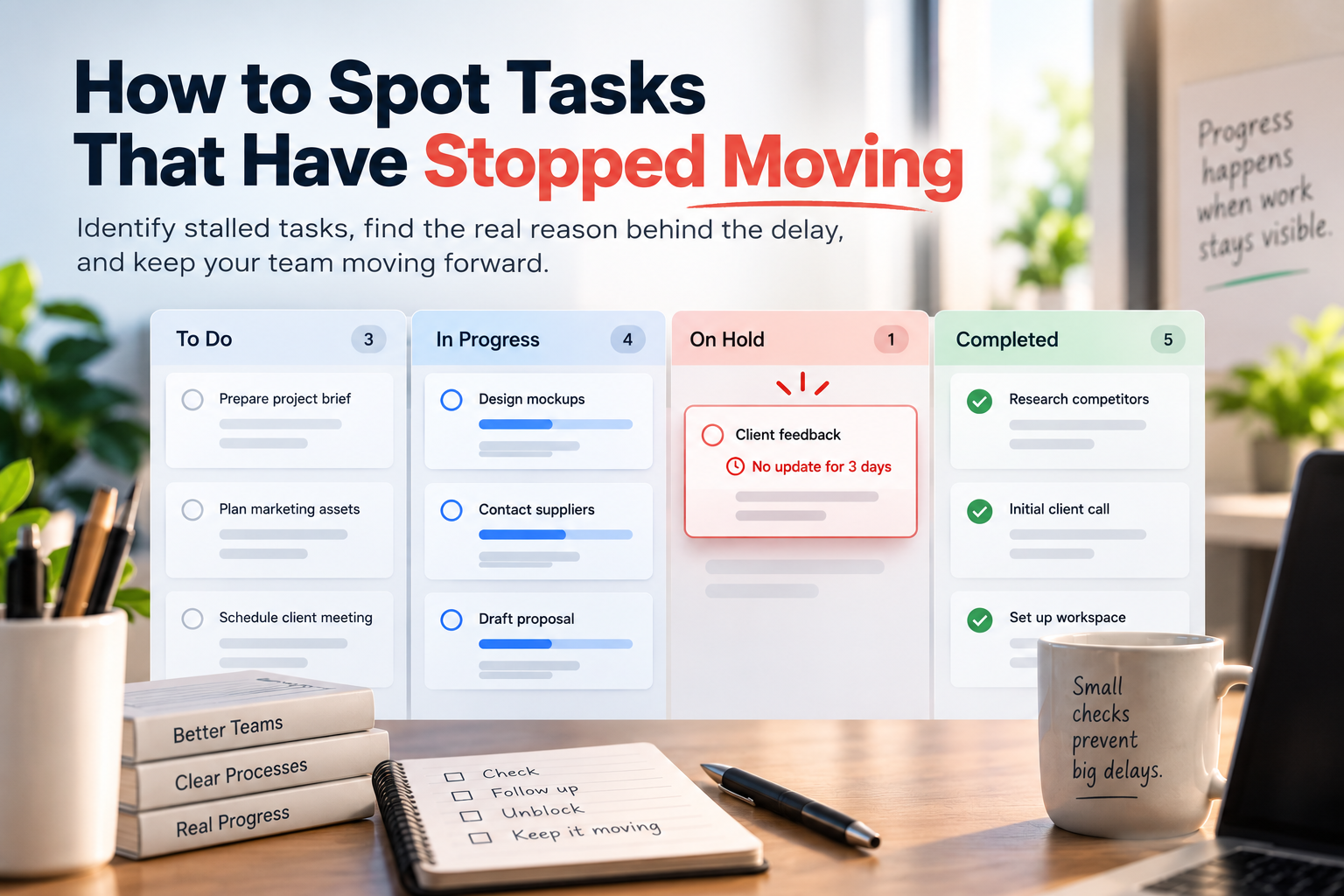
A task can look perfectly normal in a system and still be quietly going wrong.
It has an owner. It has a title. It may even have a deadline.
But nobody has changed its status, added a progress note, completed a checklist item or explained what is blocking it for several days.
The real problem is not simply that the task is unfinished. The problem is that nothing meaningful appears to be happening—and nobody has noticed yet.
For managers and operations teams, recognising inactive work early can be just as important as tracking overdue work.
An overdue task and an inactive task are not always the same thing
Most teams pay attention to due dates.
If something was due yesterday, it is clearly late.
But imagine a task that is due next Friday. On paper, everything still looks fine. Yet the last meaningful action happened three days ago.
That silence may mean several different things:
the employee is actively working but has not recorded progress;
they are waiting for information from somebody else;
priorities changed;
the task was forgotten;
ownership is unclear;
a blocker has appeared;
the work no longer needs to be done.
A due date alone cannot explain which situation applies.
That is why teams should consider task movement, not simply task completion.
What counts as a meaningful task update?
Not every system activity should reset the clock.
Opening a task, viewing it or making an insignificant edit does not necessarily mean the work progressed.
A meaningful update could include something such as:
moving the task to another genuine progress stage;
completing an important checklist item;
adding a progress note that explains what changed;
recording a blocker;
requesting a decision or dependency;
completing the work;
changing ownership for a legitimate operational reason.
The exact definition depends on the organisation.
A creative agency may expect an update every day on a time-sensitive client project. A finance team may reasonably leave a monthly reconciliation task untouched for several days.
The important part is defining what “no movement” actually means for that workflow.
The question managers should ask is not simply “Is it late?”
A stronger review question is:
“This task hasn’t moved in three days. Is anyone watching it?”
That does not automatically mean somebody has failed.
It creates a reason to investigate.
Consider a customer proposal assigned on Monday and due Friday.
By Thursday morning, the task has not changed.
A manager who only checks overdue work sees nothing unusual because the deadline has not passed.
A manager reviewing activity can ask earlier:
Has the work started?
Is somebody waiting for customer information?
Was another priority introduced?
Does the assignee need help?
Is Friday still realistic?
The purpose of visibility is not to automatically blame the person responsible. It is to make the situation visible while there is still time to respond.
Clear ownership matters just as much as activity
Inactive work becomes harder to manage when responsibility is vague.
TrueValue Platform has previously explored this operational problem in its guide on why work gets delayed when task ownership is unclear. Read the task ownership guide
A practical task-management process should make three things easy to answer:
Who owns the next action?
What does progress look like?
When should somebody review the task if progress stops?
Without those answers, adding more reminders can simply create more noise.
Managers need context, not another notification inbox
A stalled-task review should lead to a decision.
For example:
No update → Review context → Identify blocker → Decide next action
The manager might decide to leave the task alone, contact the assignee, change the priority, resolve a dependency or reassign the work.
That human judgement matters because inactivity by itself does not explain the cause.
The same principle applies when looking at team workload. A person with twelve tasks is not automatically overloaded, just as a three-day-old task is not automatically stuck. Context matters. TrueValue Platform discusses this principle further in its guide to understanding uneven team workload. Read the workload management guide
A simple stalled-task review process
Teams do not need a complicated rule to start improving visibility.
Try this four-step process.
1. Define inactivity
Decide how long different task types can reasonably go without a meaningful update.
2. Review inactive work regularly
Look specifically for assigned work that appears not to be moving rather than reviewing only overdue tasks.
3. Ask for context
Before making assumptions, determine whether the task is progressing, blocked, waiting or forgotten.
4. Record the next action
After the review, make the outcome visible: continue, unblock, reassign, reprioritise or close.
This can turn task monitoring from passive observation into a more deliberate operating habit.What is a stalled task?A stalled task is work that shows little or no meaningful progress for a period that matters to the workflow, even if the deadline has not yet passed.
Is an inactive task the same as an overdue task?No. An overdue task has passed its deadline. An inactive task may still be within its deadline but show no meaningful progress or update.
How can managers identify inactive work?Review assigned work for meaningful status changes, progress notes, blockers, dependencies and recent activity rather than looking only at due dates.
Should software automatically reassign stalled tasks?Not necessarily. Lack of activity does not explain the cause. Managers should review context before deciding whether to unblock, reprioritise, reassign or leave the task unchanged.
Better task management is about making work visible
TrueValue Platform Task currently supports structured work management including assigning tasks, tracking progress and using checklists and SLA tracking.
Those foundations help teams organise who is responsible and where work sits in the process.
But regardless of the software a business uses, one principle remains useful:
Do not wait until a deadline is missed to ask whether work is moving.
Look for silence.
Look for blockers.
Look for tasks that still appear active but have stopped producing meaningful progress.
Sometimes the most useful task-management question is not:
“Is this finished?”
It is:
“Has anything actually happened?”
To explore how the current TrueValue Platform Task Product can fit into your team’s work-management process, Request a Demo.
Related Articles & Insights
Continue exploring connected workflows, product playbooks, and strategic guides.

The Real AI Transformation Is Workflow Redesign — Not Just Adding Another Tool
Adding AI to an old workflow does not automatically transform work. Learn a practical five-step method for redesigning processes around people, ownership and AI.

Employee A Has 12 Tasks. Employee B Has 3. What Does That Tell You?
Employee A has 12 tasks while Employee B has 3. Learn why workload balance requires more than equal task counts and how to review, prioritise and redistribute work.
.png)
How Many Business Tools Are Quietly Slowing Your Team Down?
Reduce manual handoffs, repeated data entry and disconnected workflows. Discover how connected business systems can help your teams work better together.