What Happens When Customer Follow-Ups Are Kept in Different Places?
Discover how scattered customer follow-ups cause missed actions, repeated conversations and lost context, and how to create a clearer process.
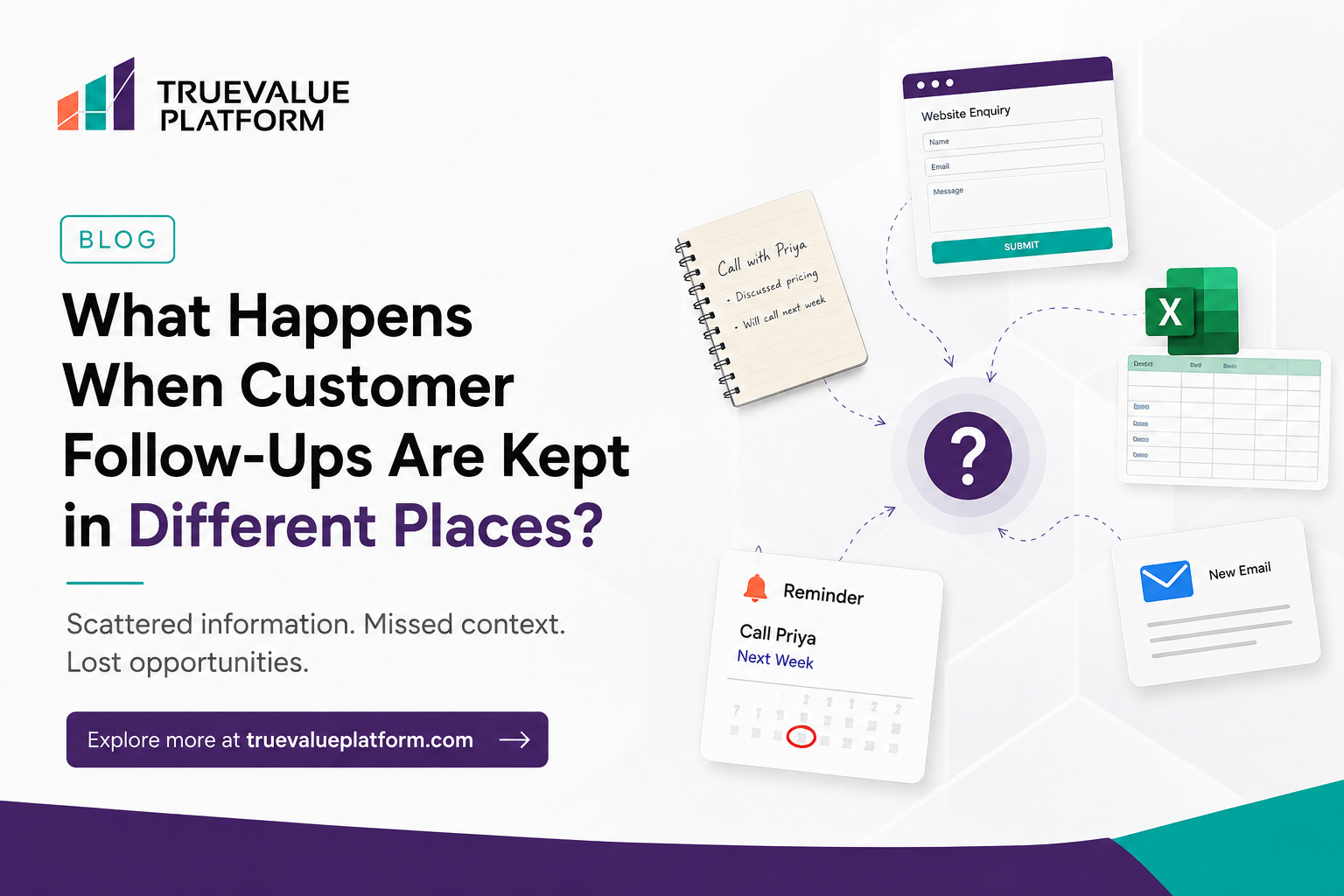
A customer sends an enquiry through your website on Monday morning.
Someone copies the details into a spreadsheet. A sales representative calls the customer and writes the outcome in a notebook. The customer replies by email the next day, but that message stays in one employee’s inbox. A reminder to call again is added to a personal calendar.
By Friday, the manager asks, “What happened with that enquiry?”
Nobody has a complete answer.
The team has information. The problem is that the information is kept in different places.
The follow-up exists, but the process does not
Many follow-up problems are not caused by employees ignoring customers. They happen because each person uses a different method to remember what needs to happen next.
One employee relies on email flags. Another keeps a spreadsheet. Someone else uses chat messages, handwritten notes or calendar reminders.
Each method may work for the individual using it. It becomes unreliable when several people are involved in the same customer journey.
A note saying “call next week” may not explain:
Who should make the call
The exact date it is due
What was discussed previously
What the customer is waiting for
Whether anyone has already responded
When that context is missing, the team spends time searching, asking colleagues and reconstructing conversations instead of helping the customer.
This is why businesses often begin looking for a more structured approach to CRM and customer management.
Customers experience the gaps before managers see them
Imagine a fictional service business receiving an enquiry from a potential customer named Priya.
Priya first asks about pricing through a website form. A team member calls her, but she requests another conversation after discussing the service with her business partner. The employee adds a reminder to a personal calendar.
Two days later, Priya emails a different team member with a question. That employee answers the question but does not know about the promised call.
When the original reminder appears, Priya receives another message asking for information she has already provided.
From the company’s perspective, two employees were being helpful. From Priya’s perspective, the business was not listening.
Fragmented follow-ups often create experiences like this:
Customers repeat the same information
Two employees contact the customer about the same issue
Important questions remain unanswered
Promised calls happen late or not at all
Opportunities appear active even when no progress is being made
The damage is not always dramatic. Sometimes the customer simply becomes quieter and eventually chooses another provider.
Scattered information weakens accountability
When follow-ups are stored across personal systems, managers cannot easily separate a workload problem from a process problem.
Was the follow-up assigned? Did the employee see it? Was the customer contacted? What should happen next?
Without one visible record, these become investigation questions rather than simple status checks.
Handovers also become difficult. When an employee is absent, changes roles or leaves the business, customer context may remain inside that person’s inbox, notes or memory.
A colleague taking over the relationship may know the customer’s name but not the history behind it.
The hidden cost is more than one missed call
Scattered follow-ups create small delays that accumulate across the business.
Employees search for previous messages. Managers repeatedly ask for updates. Customers wait while team members confirm what has already happened. Sales opportunities remain open without a clear next action.
The business may also struggle to understand why certain enquiries are not progressing. If follow-up activity is stored in several places, there is no dependable view of which customers are waiting, which actions are overdue and where conversations are becoming stuck.
Businesses reviewing their wider operating processes can explore the connected Products within the TrueValue Platform Product ecosystem.
How can a business organise follow-ups?
The answer is not simply to send more reminders. A reminder without context can still produce a poor conversation.
A useful follow-up process should record five things.
1. The customer
Connect the follow-up to the relevant lead, contact, deal or customer record.
2. The owner
Assign one person who is responsible for the next action. Shared responsibility can quickly become no responsibility.
3. The due date
“Later” and “next week” are difficult to manage. Use a clear date and, where necessary, a time.
4. The context
Record what happened, what the customer needs and what has already been promised.
5. The outcome
After the follow-up, document whether the customer responded and what should happen next.
Teams should also agree on one rule: if a follow-up affects the customer relationship, it must be recorded in the shared process rather than kept only in a private note.
A simple follow-up health check
Review ten recent customer enquiries and ask:
Can one person see the full interaction history?
Does every open follow-up have an owner?
Are overdue actions visible?
Can another employee continue the conversation without asking the customer to start again?
Can a manager understand what is moving forward and what is stuck?
Several “no” answers usually indicate that the business does not have a people problem. It has a visibility problem.
Bringing the customer story together
This is the type of problem that TrueValue CRM is designed to simplify.
TrueValue CRM supports customer records, activities and structured follow-ups so teams can keep relevant information connected to the customer journey. Its documented capabilities include leads, contacts, companies, deals, activities and follow-up records.
The aim is not to create another place for employees to check. It is to replace scattered reminders with a clearer shared process.
When follow-ups have an owner, a due date, context and a recorded outcome, customers receive a more consistent experience. Employees spend less time searching for information, and managers gain a clearer view of what needs attention.
The most important change is simple: customer follow-ups should belong to the business process, not to one person’s memory.
Explore more at TrueValue Platform.
Frequently Asked Questions
What is customer follow-up management?
Customer follow-up management is the process of recording, assigning and tracking the actions that should happen after a customer interaction. This may include a call, email, appointment, quotation, document request or sales conversation.
Why do businesses miss customer follow-ups?
Follow-ups are often missed because reminders and customer information are stored across personal calendars, spreadsheets, inboxes, notebooks and chat messages. When there is no shared process, ownership and deadlines become unclear.
What information should a customer follow-up include?
A useful follow-up should include the customer record, responsible employee, due date, previous conversation context, required action and final outcome.
How does a CRM help with customer follow-ups?
A CRM can keep customer details, activities, follow-up records and related sales information together. This gives employees and managers a clearer view of previous interactions and upcoming actions.
How can managers identify overdue customer follow-ups?
Managers need a shared system where follow-ups have clear owners and due dates. This makes overdue actions easier to identify without searching through individual inboxes or asking employees for manual updates.
Should customer follow-ups be stored in spreadsheets?
Spreadsheets may work for a small number of simple records, but they can become difficult to manage when several employees are updating customer information. They may also lack clear activity history, ownership and connected customer context.
Related Articles & Insights
Continue exploring connected workflows, product playbooks, and strategic guides.

AI Agents Are Everywhere. But Is Your Customer Data Ready for Them?
AI agents depend on the customer information behind them. Learn how data quality, CRM structure and connected customer context can prepare businesses for AI.

A Full CRM Is Not a Clear CRM: 4 Details That Keep Follow-Ups Moving
A CRM can hold plenty of customer data and still be difficult to act on. Learn how four simple details can make deal ownership, reviews and follow-ups clearer.

They Replied to Your WhatsApp Campaign. Where Did the Lead Go?
Learn why WhatsApp campaign replies get lost, what information a lead-capture workflow should preserve and how Marketing and CRM can support clearer follow-up.