Will AI Agents Replace Business Software? What Changes When Work Moves From Clicks to Outcomes
AI agents may not replace business software, but they could radically change how people interact with it. Explore what happens when work shifts from navigating screens to requesting outcomes.

A salesperson opens the CRM to check a lead. Then the task system. Then the calendar. Then email to find the last customer conversation.
That has been normal business software for years: people open applications, find information, decide what to do and move the work forward.
AI agents challenge that pattern.
Instead of asking, “Which screen should I open?”, the user may increasingly ask:
“What needs my attention?”
Or:
“Prepare the follow-up and show me what requires approval.”
So, will AI agents replace business software?
Probably not. But they may change which parts of business software people actually see and use every day.
The software may stay. The clicking may shrink.
Traditional SaaS is built around interfaces: dashboards, tabs, forms, menus and reports.
Agentic AI adds another layer. An agent can interpret an objective, gather context from authorised systems, take permitted steps and return an outcome or decision point to a person.
In July 2026, Gartner estimated that up to $234 billion in enterprise application SaaS spending could be exposed to “agentic arbitrage” by 2030, representing roughly 20% of enterprise application SaaS spending. The bigger idea is not that software suddenly disappears. It is that agents may reduce how often people need to interact directly with multiple software interfaces.
Think about the difference:
Traditional workflow
Open app → find record → check status → decide → update → switch app → repeat.
Agent-shaped workflow
State outcome → agent checks permitted systems → prepares or completes allowed steps → human reviews important decisions.
The value starts shifting from:
“How many features are on this screen?”
to:
“How reliably can this system help work reach the right outcome?”
But here’s the part people miss: the agent still needs somewhere to work
A customer still has a record.
A deal still has an owner.
An appointment still has a time.
A task still needs responsibility.
A hiring decision still needs evidence and human judgement.
AI agents do not remove these realities. They depend on them.
If the CRM says one thing, a spreadsheet says another and someone’s private messages contain the latest update, the agent inherits the same fragmented context that already frustrates the team.
That makes five seemingly boring questions extremely important:
Which system is the source of truth?
Who owns this record?
What can the agent read?
What can it change?
Which actions still require human approval?
Before asking “Do we need an AI agent?”, businesses may need to ask a more useful question:
“Is our workflow ready for one?”
That is also why customer-data readiness matters before AI is given more responsibility.
What if the next software interface is not a dashboard?
Microsoft’s 2026 Work Trend Index reports that active agents in the Microsoft 365 ecosystem grew 15x year over year. Its broader research suggests that as agents take on more execution, people increasingly move towards setting intent, applying judgement and owning outcomes.
That could change how people interact with business systems.
Instead of opening several dashboards, a manager may ask:
“Which customer commitments are at risk today?”
A team lead might ask:
“Which work is blocked, and who needs to act?”
The dashboard does not necessarily disappear.
It becomes somewhere you inspect, verify, investigate and take control when necessary — rather than the only doorway into the work.
The 4-question test: should this workflow become agent-shaped?
Do not start with:
“Where can we add AI?”
Take one real workflow and test it instead.
1. Is the outcome clear?
“Follow up with leads” is vague.
“Identify leads with no response for five working days and prepare the next follow-up for review” gives the system a much clearer objective.
2. Is the context reliable?
If nobody can confidently identify the correct customer, owner, status or history, automation simply adds speed to uncertainty.
3. Are the permissions clear?
Reading a customer record is one level of access.
Drafting a message is another.
Changing a deal status or sending something externally is another again.
4. Where does the human step in?
Important customer, employment and commercial decisions should not become invisible merely because software can execute steps quickly.
If these four questions are difficult to answer, the workflow probably needs redesign before it needs an agent.
Connected business software may become more important, not less
This is why “AI will replace SaaS” is too simple.
When work moves from clicks towards outcomes, the systems underneath still need to preserve context, permissions, ownership and history.
TrueValue Platform takes a connected-business approach across purpose-built Products such as CRM, Appointments, Marketing, Site Flow, Task, HR and Recruit. You can explore the TrueValue Platform Product ecosystem and see how different operational areas can sit within a more connected environment.
The useful goal is not another AI button.
It is less fragmentation.
Because when business context is clearer, people can work with better information — and any future AI or agentic layer has a stronger foundation to work from.
Frequently Asked Questions
Will AI agents make SaaS obsolete?
Not necessarily. Agents may reduce direct interaction with some software interfaces, but systems of record, permissions, workflows, data and business logic still have important roles.
What is the difference between generative AI and an AI agent?
Generative AI mainly creates or transforms content in response to instructions. An AI agent can be designed to pursue an objective across multiple steps or tools within defined boundaries.
Should businesses replace their software with AI agents now?
Not automatically. Start by identifying suitable workflows, improving the underlying data, defining permissions and deciding where human approval is required.
The question is changing
For years, businesses bought software by asking:
“What can this application do?”
Agentic AI introduces another question:
“What outcome can this combination of people, software and AI reliably produce?”
Business software is unlikely to disappear overnight.
But our relationship with it may change dramatically.
The strongest foundation for that future is not more AI buttons. It is clearer data, connected workflows, defined permissions and visible human accountability.
If your business is reviewing how its operational workflows could work with less fragmentation, Request a Demo of TrueValue Platform.
Related Articles & Insights
Continue exploring connected workflows, product playbooks, and strategic guides.

The Real AI Transformation Is Workflow Redesign — Not Just Adding Another Tool
Adding AI to an old workflow does not automatically transform work. Learn a practical five-step method for redesigning processes around people, ownership and AI.
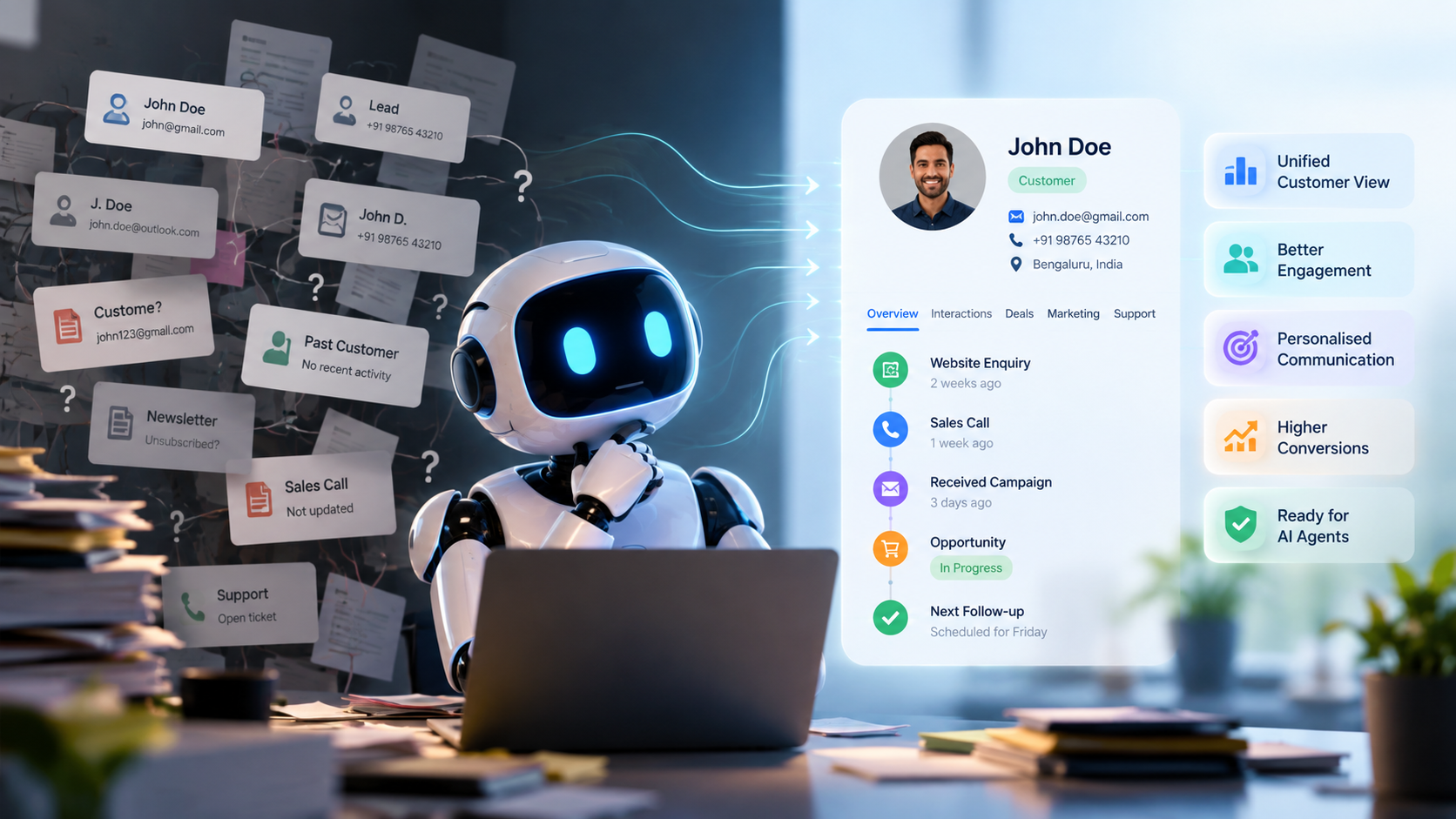
AI Agents Are Everywhere. But Is Your Customer Data Ready for Them?
AI agents depend on the customer information behind them. Learn how data quality, CRM structure and connected customer context can prepare businesses for AI.

A Full CRM Is Not a Clear CRM: 4 Details That Keep Follow-Ups Moving
A CRM can hold plenty of customer data and still be difficult to act on. Learn how four simple details can make deal ownership, reviews and follow-ups clearer.