CV Summary: Stop Reading Every CV From Line One
Learn how structured CV summaries can help recruiters identify relevant experience, skills and review points faster while keeping verification and human judgement central to hiring.
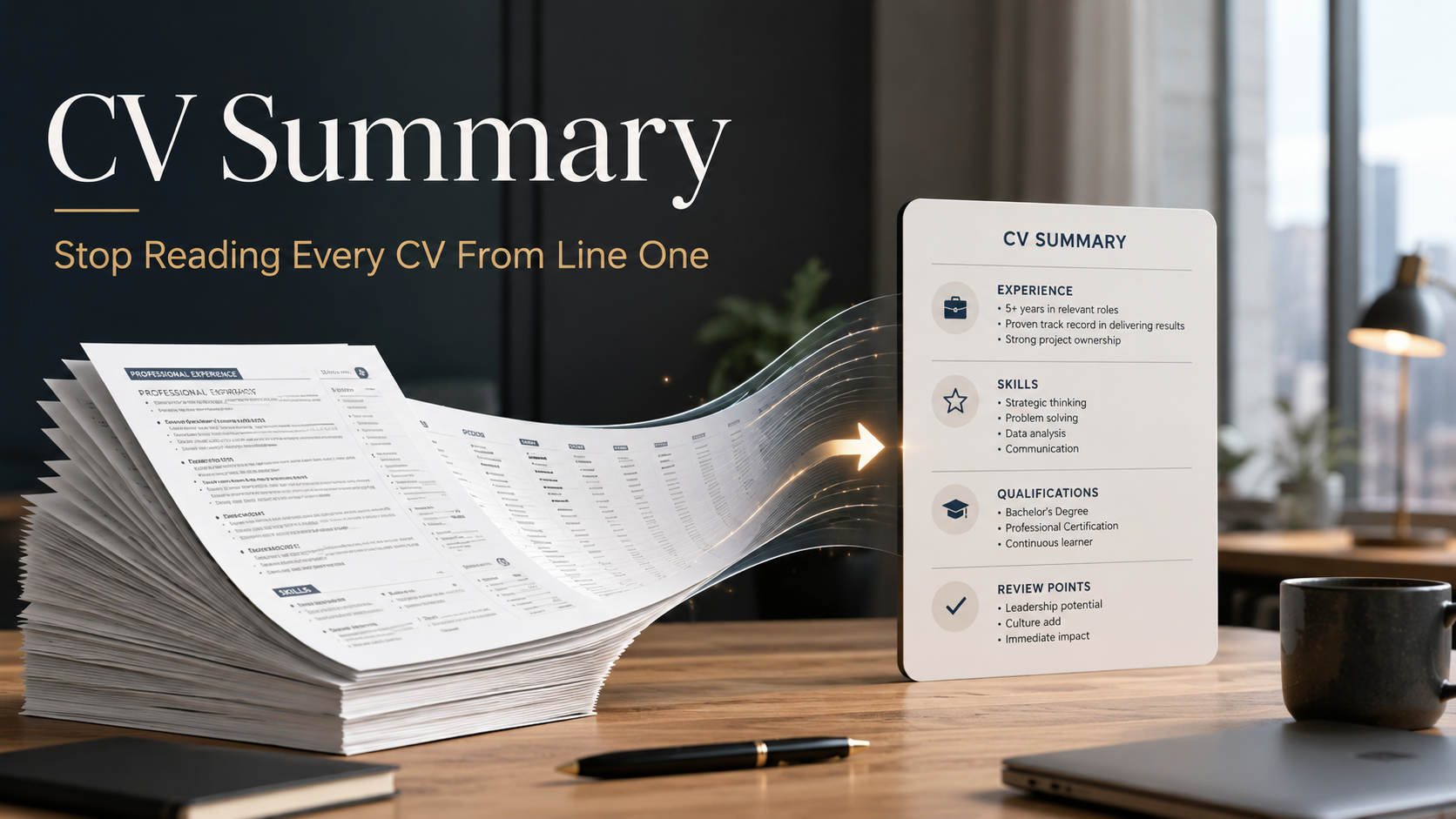
A recruiter opens a candidate’s CV.
Page one contains the profile and current role. Page two moves into previous employment. Page three explains projects. Pages four and five cover qualifications, certifications and earlier experience.
All of that information may matter.
But the recruiter does not necessarily need to read every line in sequence before understanding the candidate.
A more practical first step is a CV summary: a structured view of the candidate’s most relevant experience, skills, qualifications and areas that deserve closer review.
The important distinction is that summarisation should reduce searching, not reduce human judgement.
What Is a CV Summary?
A CV summary condenses information from a longer CV into a shorter, structured overview that helps a recruiter understand the candidate before investigating the complete application.
For example, instead of beginning with five pages of information, a recruiter might first see:
Current or most recent position
Relevant years of experience
Industries worked in
Important skills mentioned
Qualifications and certifications
Leadership or management exposure
Relevant achievements or projects
Areas requiring clarification
The original CV remains the source.
The summary is simply the map.
This approach becomes particularly useful when recruiters are reviewing multiple candidates. Our guide to AI-assisted candidate screening explores the wider principle: technology can help organise candidate information and support the first stage of review, while people remain responsible for hiring decisions.
Why Reading Every CV From Line One Creates a Problem
The issue is not simply CV length.
It is inconsistency.
Consider three applicants for the same Marketing Manager position.
Candidate A uses a two-page CV with short bullet points.
Candidate B submits five pages describing every project in detail.
Candidate C puts their strongest relevant experience on page three after a long professional introduction.
If the recruiter reviews applications purely from top to bottom, the presentation style of the CV can influence how quickly important information becomes visible.
That is not the same thing as evaluating whether the candidate is suitable.
A structured first review helps the recruiter ask the same questions of every application:
What does this candidate currently do?
Which experience is relevant to this vacancy?
Which skills are supported by their work history?
What qualifications matter for this role?
What information needs deeper investigation?
That gives recruiters a more consistent starting point for comparison.
What Should a Useful CV Summary Include?
A useful CV summary should not simply copy the candidate’s professional profile. It should organise the information around the hiring decision.
1. Current professional context
Start with the candidate’s current or most recent role.
A recruiter should quickly understand the candidate’s present level, type of work and general area of responsibility.
2. Relevant experience
Career length alone can be misleading.
A candidate may have ten years of total employment but only three years directly connected to the role being filled.
A better summary separates total background from relevant experience.
3. Skills with context
A CV might list:
CRM, Excel, SEO, project management, leadership and analytics.
That list is useful, but it is not enough.
The recruiter should still investigate how and where those skills were actually used.
A skill mentioned in a CV is information to verify, not automatic evidence of proficiency.
4. Qualifications
Relevant degrees, certifications, licences or professional qualifications should be easy to identify without searching several sections of the document.
5. Review points
A strong summary should also reveal questions.
For example:
unexplained employment periods;
overlapping dates;
frequent role changes;
important skills with limited supporting detail;
management responsibility that needs clarification;
experience that appears relevant but is described vaguely.
These should not automatically become rejection reasons.
They should become questions for further review.
The Best Summary Helps Recruiters Ask Better Questions
Suppose a recruiter receives this first-stage overview:
Current role: Senior Marketing ExecutiveExperience: Six years in marketing rolesRelevant areas: Paid advertising, campaign management, content and analyticsLeadership exposure: Supervises two junior employeesQualification: MBA in MarketingReview point: Budget responsibility is unclear
The recruiter now has a useful interview question:
“What campaign budgets have you personally been responsible for, and how did you measure their performance?”
That is more valuable than spending the first part of the interview rediscovering basic information already contained in the CV.
Good recruitment processes connect each stage rather than treating CV review, interviews, decisions and candidate communication as isolated activities. The same principle applies after a decision is made: teams still need a clear process for communicating candidate rejection professionally.
Where AI-Assisted Recruitment Fits
When a team receives many applications, repeatedly locating the same categories of information can consume attention that recruiters could use for judgement, interviews and candidate communication.
AI-assisted recruitment can help organise that information.
TrueValue Platform Recruit supports verified AI-assisted candidate screening and interview-related capabilities within a broader recruitment workflow covering jobs, applicants and candidates, pipelines, interviews, offers and successful-hire handoff.
That does not mean AI should decide who gets the job.
A CV cannot fully establish motivation, communication ability, judgement, practical competence or how someone will perform inside a particular organisation.
Those decisions still need people.
The useful model is:
AI helps organise the evidence → recruiters investigate the evidence → people make the decision.
This also matters because recruitment is only one part of the employee journey. A candidate who accepts an offer eventually moves from recruitment into employee operations. Teams can use an employee onboarding checklist to make that transition more structured after the hiring decision.
TrueValue Platform also treats Recruit and HR as separate Products while supporting a broader candidate-to-employee workflow. Our article on connected business workflows explains why reducing manual handoffs matters across recruitment, HR and other business processes.
A Practical Four-Step CV Review Process
Recruitment teams can use a simple approach:
SummariseExtract the candidate’s relevant experience, skills, qualifications and important review points.
CompareCompare candidates against consistent job requirements rather than their CV writing styles.
VerifyReturn to the full CV before relying on important claims or details.
InvestigateTurn missing context into screening or interview questions.
The objective is not to read less because candidate information is unimportant.
It is to spend more attention on the information that actually deserves judgement.
Frequently Asked Questions
Should recruiters stop reading full CVs?
No. A summary provides the starting context. Recruiters should still consult the complete CV when verifying experience, chronology, qualifications and other important information.
Can a CV summary automatically decide whether a candidate is suitable?
It should not. A summary helps organise information. Suitability requires comparison with job requirements and appropriate human assessment.
What is the main benefit of summarising a long CV?
It helps recruiters identify the most relevant information before navigating every section of a long application.
Can AI help with candidate screening?
AI-assisted tools can help organise information and support screening, but recruiters should review the underlying evidence and remain responsible for important hiring decisions.
Compress the Reading, Not the Person
A five-page CV does not need to become five pages of first-stage searching.
Start with the information that helps you understand the candidate.
Then return to the complete CV wherever evidence, clarification or professional judgement is required.
That is the useful purpose of CV summarisation:
Compress the reading. Keep the context. Preserve the human decision.
If your team wants to explore a more organised, AI-assisted recruitment workflow with TrueValue Platform Recruit, Request a Demo.
Related Articles
View all
How to Reject a Candidate Professionally Without Damaging the Candidate Experience
Learn how to write clear, respectful candidate rejection emails, adapt messages to each hiring stage and use AI-assisted drafting without removing human judgement.

A Customer Calls Your Business. Who Gets the Call?
Learn how business call routing helps direct incoming calls towards the right team, reduce unnecessary transfers and create clearer customer communication workflows.
27 Tasks. What Needs Your Attention First?
When every task looks important, deciding where to start becomes work itself. Explore how AI-assisted prioritisation can help teams focus on what needs attention first.