AI Agent Sprawl Is the Next Business Software Problem: How to Stay in Control in 2026
AI agents are multiplying across business workflows. Learn how to recognise agent sprawl and create clearer ownership, permissions, data and human oversight.

A sales team adds an AI agent for follow-ups. Marketing introduces another for campaign work. HR tests one for employee queries. Customer service starts using its own assistant.
Each decision may make sense on its own.
The problem appears later, when nobody can clearly answer: Which agent owns what? Which customer record is correct? What can each agent access? Who reviews its actions? And are two agents doing the same job in different systems?
This is AI agent sprawl — and it is becoming an important operational issue as businesses move from experimenting with AI to letting it participate in real workflows.
Gartner reported in April 2026 that it expects the average global Fortune 500 company to have more than 150,000 AI agents in use by 2028, while only 13% of organisations surveyed believed they had the right governance in place to manage agents.
The lesson is not “use less AI”.
It is: do not let AI multiply faster than your ability to manage the work around it.
What Is AI Agent Sprawl?
AI agent sprawl happens when multiple AI agents are introduced across a business without enough shared ownership, visibility, permissions, workflow design or lifecycle management.
Imagine a growing company with:
a sales agent checking leads;
a marketing agent preparing campaigns;
a scheduling agent arranging meetings;
a customer-service agent answering questions;
an HR agent helping employees;
another agent added inside a separate SaaS product.
The individual agents are not necessarily the problem.
The problem starts when they operate around different data, duplicate responsibilities or take actions without a clear operating model.
This resembles an earlier business-software problem: SaaS sprawl. Companies accumulated separate tools because each solved one problem. Eventually, employees spent more time switching systems, copying information and resolving inconsistencies.
AI agents can create a similar pattern, with additional complexity around permissions, actions and accountability.
Five Signs Your Business Is Developing Agent Sprawl
1. Two Agents Are Solving the Same Problem
Sales may create an agent for lead follow-ups while Marketing deploys another agent that also communicates with leads.
Both appear useful until their responsibilities overlap.
Before creating an agent, define its purpose in one sentence:
“This agent is responsible for ___ within ___ workflow, owned by ___.”
If you cannot complete that sentence clearly, the scope probably needs more work.
2. Different Agents See Different Versions of the Customer
An intelligent agent working with incomplete information is still working with incomplete information.
If the CRM contains one status, a spreadsheet contains another and the latest conversation is sitting inside someone’s private messages, an agent has no reliable operational truth.
This is why customer-data readiness should come before increasingly autonomous workflows.
Ask:
Where should the agent look when two systems disagree?
Every important business entity — lead, customer, employee, appointment, task or candidate — needs an identifiable source of truth.
3. Nobody Owns the Agent’s Outcome
“IT manages the agent” is not the same as business ownership.
Suppose an agent prepares sales follow-ups.
Who decides whether the follow-up logic is still appropriate?
Who investigates mistakes?
Who reviews exceptions?
Who determines whether the agent should be changed, paused or retired?
Every operational agent needs a human owner responsible for the business outcome — not merely the technology.
Microsoft described its own AI transformation in September 2026 as human-led, with people retaining meaningful control, judgement and accountability even as AI becomes more involved in work.
That principle becomes increasingly important as agents move from suggesting actions to executing them.
4. Permissions Are Broader Than the Job Requires
An agent that needs to read a customer record does not automatically need permission to modify it.
And an agent that prepares a message does not automatically need authority to send it.
A useful permission model separates four levels:
Read → Prepare → Act → Escalate
For example:
An agent may read lead history, prepare the next follow-up and present it to the salesperson.
The salesperson approves the message.
Only then is the external action taken.
The right level depends on the workflow, risk and importance of the decision.
5. Nobody Knows When an Agent Should Be Retired
Businesses usually have a process for adding software.
They are often much worse at removing it.
AI agents need lifecycle management too.
Every agent should periodically be reviewed:
Is it still needed?Does another agent now perform the same job?Is the workflow still the same?Are its permissions still appropriate?Who currently owns it?
An agent without an active purpose should not remain connected simply because nobody remembered to remove it.
A Simple Six-Step Agent Governance Checklist
Before introducing another AI agent, document:
Outcome: What specific business result should it support?
Workflow: Where does it enter and leave the process?
Owner: Which person is accountable for its operation?
Data: Which records are authoritative?
Permissions: What may it read, prepare, change or send?
Human checkpoint: Which decisions require review or escalation?
This does not require a massive AI-governance programme for every small business.
It requires operational discipline.
The same principle applies to AI workflow redesign: start with how work should move, then decide where AI belongs.
Connected Operations Become More Important as AI Expands
Agent sprawl is partly an AI problem.
But underneath it is often an old operational problem: disconnected systems.
Customer information lives in one place. Tasks live somewhere else. Appointments sit in another system. Marketing activity has separate records. Teams move updates manually between them.
Adding agents on top of fragmented operations can create another layer that businesses must reconcile.
TrueValue Platform takes a connected-business-operations approach across purpose-built Products including CRM, Appointments, Marketing, Site Flow, Task, PBX, HR and Recruit. Businesses reviewing their operational software can explore the TrueValue Platform Product ecosystem.
The important distinction is that connected software does not automatically solve AI-agent governance.
What it can provide is something increasingly valuable: clearer operational context, ownership and workflows underneath the AI layer.
That foundation matters.
Frequently Asked Questions
Is AI agent sprawl the same as shadow AI?
Not exactly. Shadow AI generally refers to AI tools being used without organisational approval or visibility. Agent sprawl can happen even when every agent was officially approved — because responsibilities, permissions and ownership gradually become fragmented.
How many AI agents should a business have?
There is no ideal number. Ten clearly scoped agents may be easier to manage than three agents with overlapping responsibilities and unclear access. Focus on purpose and governance rather than agent count.
Should small businesses worry about AI agent governance?
Yes, but governance should match the scale and risk of the business. Even a simple register showing each agent’s purpose, owner, permissions and connected systems can create valuable visibility.
Will connected business software prevent agent sprawl?
Not by itself. Agent governance still requires clear ownership and controls. Connected workflows can, however, reduce some of the fragmented data and manual hand-offs that make AI systems harder to manage.
Add AI Deliberately, Not Accidentally
The next stage of business AI will not be defined simply by how many agents a company deploys.
It will depend on whether those agents understand the right context, operate within clear boundaries and support workflows that people can still understand and control.
Before adding your next AI agent, ask:
What does it own?What information does it trust?What is it allowed to do?Who remains accountable?
Businesses that can answer those questions are better prepared for an increasingly agentic workplace.
If your organisation is first trying to reduce fragmented customer, task, appointment and operational workflows, Request a Demo of TrueValue Platform.
Related Articles & Insights
Continue exploring connected workflows, product playbooks, and strategic guides.

Will AI Agents Replace Business Software? What Changes When Work Moves From Clicks to Outcomes
AI agents may not replace business software, but they could radically change how people interact with it. Explore what happens when work shifts from navigating screens to requesting outcomes.

The Real AI Transformation Is Workflow Redesign — Not Just Adding Another Tool
Adding AI to an old workflow does not automatically transform work. Learn a practical five-step method for redesigning processes around people, ownership and AI.
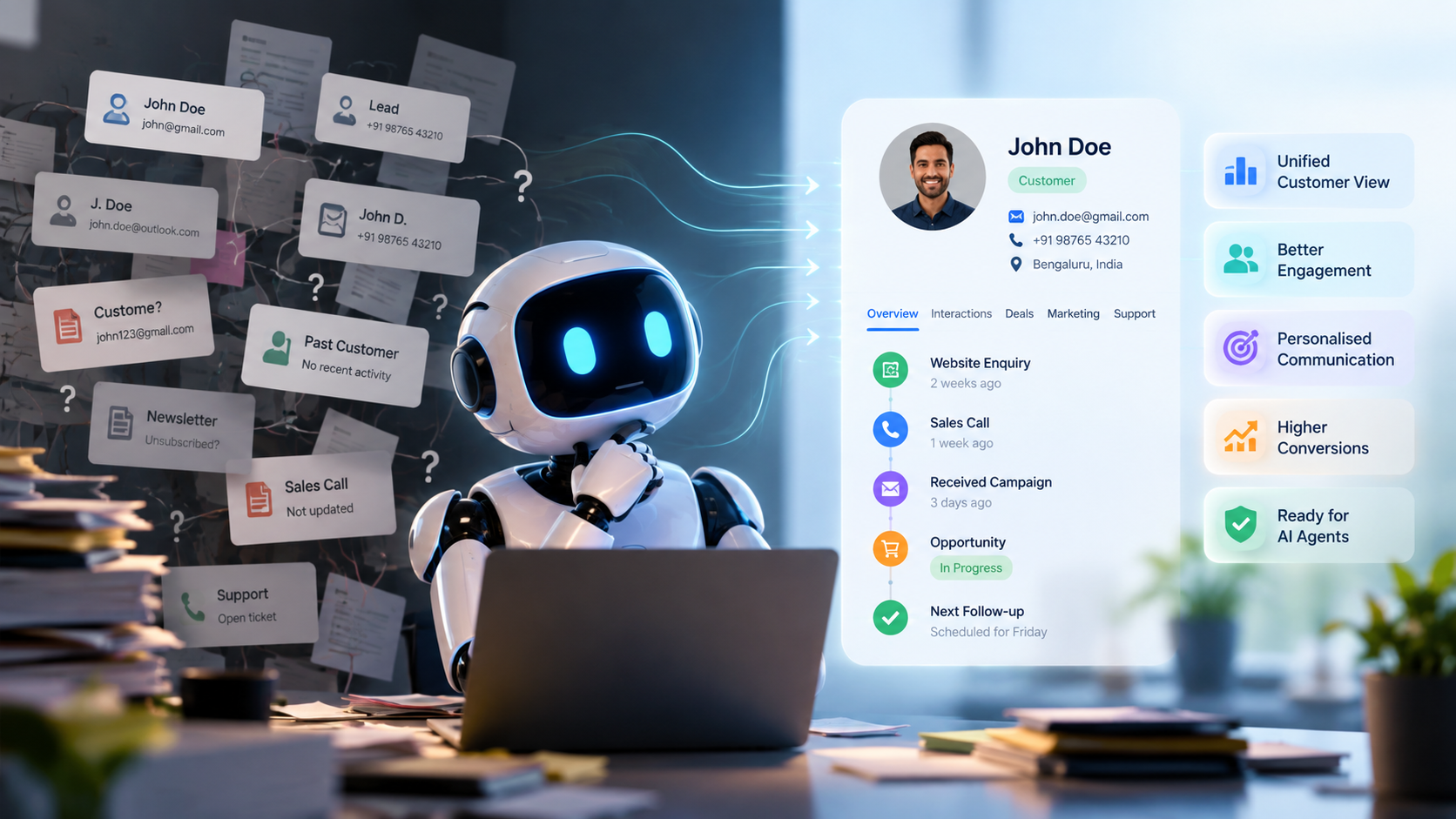
AI Agents Are Everywhere. But Is Your Customer Data Ready for Them?
AI agents depend on the customer information behind them. Learn how data quality, CRM structure and connected customer context can prepare businesses for AI.