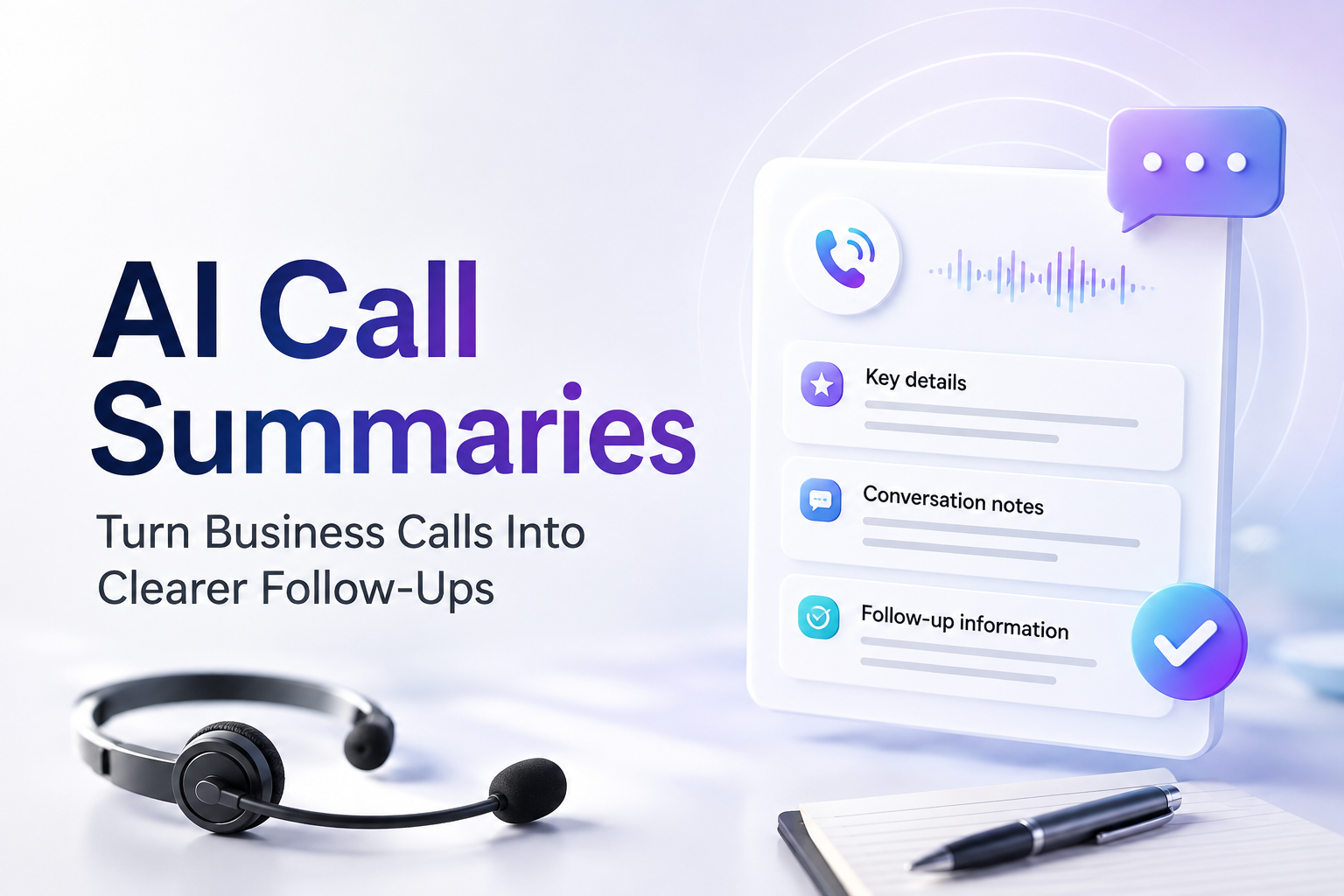
AI Call Summaries: Turn Business Calls Into Clearer Follow-Ups
AI-assisted call summaries can help teams capture key conversation details, organise notes and create clearer follow-ups without relying entirely on manual note-taking.
A customer call can last five minutes.
Remembering everything that mattered from that conversation can take considerably longer.
A customer may mention a budget, ask for a callback, confirm a requirement, raise a concern and agree on the next step — all in the same conversation.
By the time the call finishes, the person handling it may already be moving on to another customer.
That is where information starts getting lost.
Manual notes can be incomplete. Important details may remain in someone's notebook. Follow-up instructions may sit in a chat message. Another team member may have to replay or review the conversation simply to understand what happened.
AI-assisted call summaries can help turn a conversation into organised, reviewable information that makes the next action easier to understand.
What Is an AI Call Summary?
An AI call summary is a structured overview of a business conversation created with assistance from artificial intelligence.
Instead of treating a call as one long block of conversation, a summary can help organise useful information into categories such as:
key discussion points;
customer requirements;
important conversation notes;
questions or concerns raised;
decisions made during the call; and
information relevant to follow-up.
The purpose is not to remove human judgement from customer communication.
It is to make useful information easier for people to review.
That distinction matters.
A salesperson still decides how to handle the relationship. A manager still decides what needs attention. A support employee still needs to understand the customer's situation.
AI can assist with organising information. People remain responsible for interpreting it and deciding what happens next.
The Real Problem: Important Call Details Are Easy to Lose
Consider a typical sales conversation.
A customer tells a salesperson:
“The budget should be approved next week. Could you send the revised proposal by Friday? Call me again after Tuesday.”
Three important pieces of information are hidden inside that short conversation:
Budget: approval may happen next week.
Action: revised proposal needs to be sent by Friday.
Follow-up: customer wants another call after Tuesday.
If the salesperson is taking notes manually while speaking, one of those details may be missed.
The information can then become scattered across:
handwritten notes;
personal reminders;
phone call logs;
messaging apps;
spreadsheets;
emails; and
CRM records.
The problem is not simply note-taking.
The bigger problem is what happens after the call.
Why Better Call Summaries Matter
1. Teams Can Review Key Details Faster
Most people do not need to review an entire conversation to understand what happened.
They usually need the important information.
A structured summary can help someone quickly understand the customer's request, the main discussion points and the expected next action.
That can be especially useful when another employee needs to continue the conversation.
Instead of asking:
“What did the customer say?”
the team can begin with organised context.
2. Follow-Up Becomes Clearer
A good customer conversation loses value when the agreed next step is forgotten.
Follow-up information may include:
call the customer on a particular day;
send a proposal;
confirm pricing internally;
arrange another meeting;
provide requested information; or
ask another department to take action.
Making those details easier to review can support more organised follow-through.
For teams already managing leads and customer activity, connecting communication with a structured customer process becomes even more important.
You can explore how TrueValue CRM fits into a more organised approach to customer and sales workflows.
3. Less Dependence on Memory
People are not designed to remember every detail from every business conversation.
This becomes even harder when employees handle several calls every day.
Relying on memory creates a person-dependent workflow.
If the employee forgets a detail, is unavailable or hands the account to someone else, context can disappear.
Clear conversation records make knowledge easier to carry forward.
4. Managers Get Better Context
Managers often need answers to questions such as:
What did the customer ask for?
Was a next step agreed?
Does somebody need to follow up?
Is the customer waiting for information?
Was an issue raised that needs attention?
Without organised call records, managers may need to ask the employee, search through notes or review a long conversation.
Structured summaries can make the important context easier to identify.
AI Call Summaries Should Assist People — Not Replace Them
AI-generated information should not automatically be treated as perfect.
Names can be misunderstood.
Technical terms can be interpreted incorrectly.
Important context can occasionally be missing.
That is why the most useful approach is AI-assisted, not AI-dependent.
The summary should help the employee review the conversation faster while leaving room for human verification.
A simple workflow might look like this:
Call happens → summary is generated → employee reviews important details → next action is confirmed → team follows up.
That keeps human judgement at the centre of the process.
Call Summaries Become More Useful When Communication Is Connected
A summary by itself is useful.
Call summaries become more useful when the information they contain can be reviewed alongside the wider customer workflow.
For example, a business might use a process such as:
Customer call → conversation record → summary reviewed by an employee → relevant customer information updated → next action confirmed.
The exact workflow depends on the communication and business software a company uses.
TrueValue Platform is designed around connected business operations, bringing purpose-built Products together through one Platform.
Businesses can explore the wider Product ecosystem through the All Products page.
For business calling specifically, TrueValue PBX is the Product focused on business telephony workflows such as calling, extensions, call logs and routing.
The broader goal is straightforward:
do not let valuable customer information disappear when the phone call ends.
From Conversation to Action
Think about two different ways of handling the same customer call.
Without a Structured Summary
The employee finishes the call.
They write two quick notes.
One important request is forgotten.
The customer asks about it three days later.
Another employee has no idea what was previously discussed.
Everyone spends additional time rebuilding context.
With a Clear Call Summary
The conversation finishes.
Important points are organised for review.
The employee confirms the relevant details.
The next action becomes easier to identify.
Another team member can understand what happened without beginning from zero.
The difference is not simply better documentation.
It is clearer operational follow-through.
Where AI-Assisted Call Summaries Can Be Useful
This approach can be relevant anywhere important decisions happen over the phone.
Sales Teams
Salespeople can review requirements, objections and follow-up information before their next conversation.
Customer Service Teams
Support employees can understand previous discussion points before continuing an issue.
Account Management
Account managers can maintain context across recurring customer conversations.
Recruitment Teams
Recruiters regularly handle phone conversations containing availability, role expectations and follow-up requirements.
Service Businesses
Businesses handling bookings, enquiries and customer requests over the phone can benefit from clearer conversation records.
The exact information that matters will vary by business.
The principle remains the same:
important conversations should create useful business context, not disappear into a call history.
Three Questions to Ask About Your Current Call Process
Before introducing another tool, examine how your team handles calls today.
1. Where do important call notes go?
If the answer depends on the employee, information may already be fragmented.
2. Can another person understand what happened?
A useful call record should make sense to somebody who was not part of the original conversation.
3. Is the next action clear?
A conversation record is much more useful when the team can understand what needs to happen next.
These questions help identify whether the real problem is calling itself or the process that surrounds the call.
Building a More Connected Customer Communication Workflow
Improving customer communication does not necessarily mean adding more software.
Often it means connecting the information that already exists.
Calling, customer records, follow-ups and team ownership should support one another rather than operate as isolated activities.
TrueValue Platform is built around that connected-operations approach.
You can explore:
TrueValue PBX for business calling workflows;
TrueValue CRM for customer and sales workflows;
All TrueValue Products to explore the wider connected Product ecosystem; and
the TrueValue Platform Blog for practical guides on business operations, communication and connected workflows.
Final Thoughts
A business call contains more than words.
It contains customer intent, requests, decisions, concerns and potential next actions.
When those details remain trapped inside the conversation, teams have to depend on memory, manual notes and repeated explanations.
AI-assisted call summaries offer a different approach: organise the conversation into clearer information that people can review and act on.
The technology should not replace the employee's judgement.
It should help the employee spend less time reconstructing what happened and more time deciding what should happen next.
For growing teams, that can mean clearer records, more organised follow-up and better continuity between conversations.
See How TrueValue Platform Fits Your Workflow
Want to explore how TrueValue Platform can support more connected customer, calling and follow-up workflows?
A personalised demo can help you explore the currently available Products and determine how they may fit your business processes.
Related Articles & Insights
Continue exploring connected workflows, product playbooks, and strategic guides.

Dashboard Sprawl in 2026: Why More Reporting Can Make Decisions Slower
More dashboards do not always create better decisions. Learn how dashboard sprawl creates reporting friction and how to move from visibility to action.

AI Agent Sprawl Is the Next Business Software Problem: How to Stay in Control in 2026
AI agents are multiplying across business workflows. Learn how to recognise agent sprawl and create clearer ownership, permissions, data and human oversight.

Will AI Agents Replace Business Software? What Changes When Work Moves From Clicks to Outcomes
AI agents may not replace business software, but they could radically change how people interact with it. Explore what happens when work shifts from navigating screens to requesting outcomes.